
Every winter, Ukrainian roads become a challenge for drivers. However, it is not the weather that determines safety, but the condition of the tyres. Wear and tear on winter tyres reduces traction by 50–70%, turning a normal journey into a risky undertaking. According to the patrol police, bald tyres are the cause of one in five accidents between November and March.
In this article, you will learn why worn tread is dangerous not only for the driver but also for their wallet. An analysis of real threats, legal regulations and practical alternatives will help you make the right decision before the winter season.
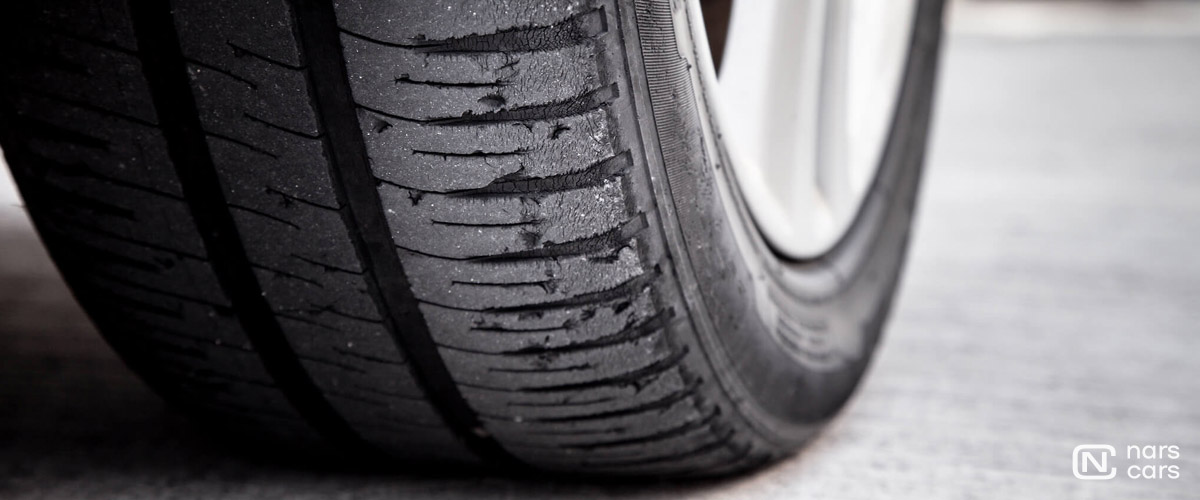
Bald tyres in action: the main threats on winter roads
Winter tyres work differently from summer tyres. Their tread is designed to remove snow, water and ice particles from the contact patch. Deep grooves and thousands of small sipes create “grip” on slippery surfaces. When the tread wears down, this entire system stops functioning, causing the car to lose traction with the road.
Increased braking distance: the shocking difference between new and worn tyres
A car’s ability to stop at the right moment depends directly on the depth of the tread. The German automobile club ADAC conducted a series of tests, the results of which clearly demonstrate this relationship. When braking from a speed of 50 km/h on an icy road, a new tyre with an 8 mm tread stops the car in 35 metres. The same tyre, but with a tread depth of 4 mm, increases the distance to 45 metres. With a residual tread depth of 1.6 mm, the braking distance reaches 60 metres.
The 25-metre difference between new and worn tyres — is the distance that can separate a safe stop from a collision with the vehicle ahead or a pedestrian.
On snow-covered roads, the situation is similar:
- an 8 mm tread provides a braking distance of 25 m;
- 4 mm increases it to 32 m;
- and a tread depth of 1.6 mm — already 43 m.
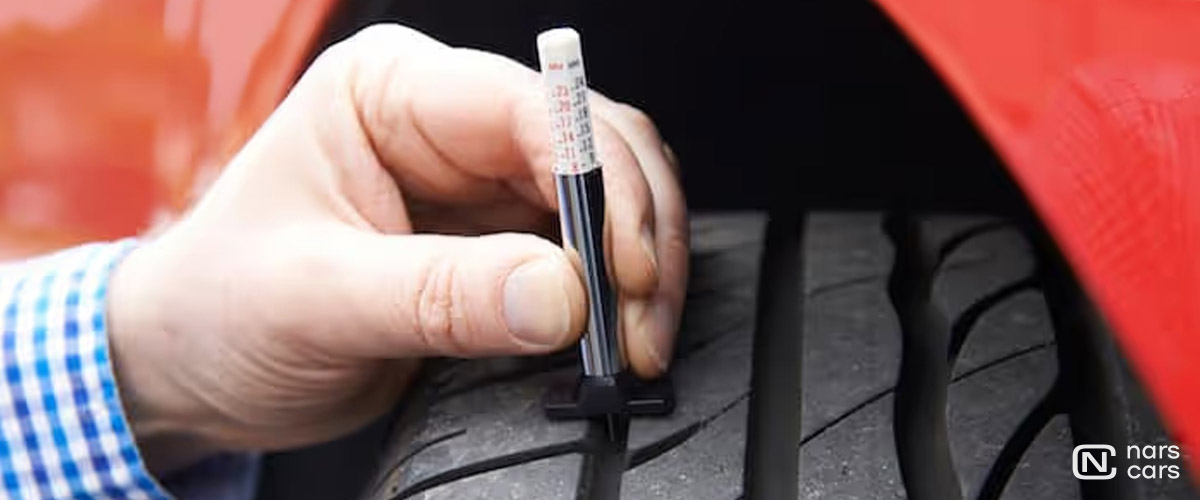
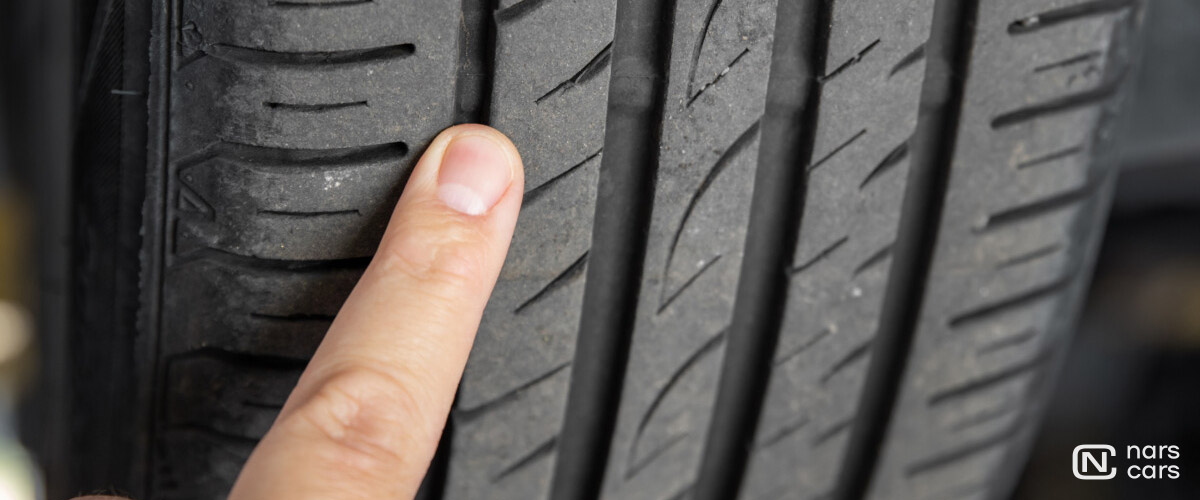
To help detect critical wear in time, manufacturers have added special markings. Where is the tyre wear indicator located? In the longitudinal grooves of the tread. It is a small rubber protrusion 1.6 mm high. Once the tread surface becomes level with this protrusion, the tyre has reached the end of its service life and must be replaced immediately.
Aquaplaning and slush planing: when the car “floats” on water and slush
Ukrainian winters are rarely consistently frosty. Thaws alternate with freezing temperatures, rain turns into snow, and a mixture of water, ice and de-icing agents forms on the roads. It is under these conditions that another threat of worn tyres appears — loss of contact with the road due to a film of water or snow.
The tread of a new winter tyre can disperse up to 30 litres of water per second. Deep grooves literally “push” water out of the contact patch, maintaining grip with the asphalt. Worn rubber can handle only 10–15 litres, while the remaining water stays between the wheel and the road. As a result, the car begins to slide like it is on water skis.
Slush planing is a related phenomenon that occurs on a mixture of melted snow and water. This “slush” is denser than ordinary water, so a worn tread cannot displace it. The car loses control at speeds of 40–50 km/h, even though the driver believes they are driving cautiously.
The risk of aquaplaning increases when several factors combine: tread depth less than 4 mm, speed above 60 km/h, a water layer on the road greater than 3 mm, and low tyre pressure.
Loss of directional stability: why a car skids even on a straight road
The danger of driving on old tyres often appears unexpectedly. The driver is travelling along a straight road without making sudden manoeuvres, yet the car suddenly begins to veer to one side. The reason for this behaviour is uneven wheel grip on the road surface.
Winter roads are uneven: patches of bare asphalt alternate with ice, compacted snow and puddles of de-icing agents. New tyres adapt to these transitions thanks to their elastic rubber and deep sipes. Worn tyres react to changes in road surface with delay and unpredictably, leading to sudden skidding.
The age of the rubber should also be taken into account. The service life of winter tyres is limited not only by tread wear but also by the ageing of the rubber compound. Even with sufficient tread depth, a tyre older than 5–6 years loses elasticity. Hardened rubber does not “fit” the micro-irregularities of the road as effectively, reducing traction by 20–30%.
Inability to start uphill and wheel spin on flat ground
The terrain of Ukrainian cities creates additional challenges in winter. Ascents and descents in Kyiv, Lviv and Kharkiv turn into obstacle courses after snowfall. Worn tyres do not provide sufficient traction to start on an incline.
Wheel spin is the first sign of a problem. The wheels rotate, but the car remains stationary or slowly slides backwards. This situation is especially common when leaving a courtyard after overnight snowfall, driving up to a shopping centre car park, or starting at traffic lights on a slight incline.
The figures explain why: a new winter tyre provides a friction coefficient of 0.4–0.5 on compacted snow, whereas a worn tyre provides only 0.2–0.25. A twofold decrease in this indicator means that the car is physically unable to overcome an incline that previously caused no difficulty.
Not just accidents: legal and financial risks of driving on worn tyres
What the Traffic Regulations say: permissible tread depth and penalties for violations
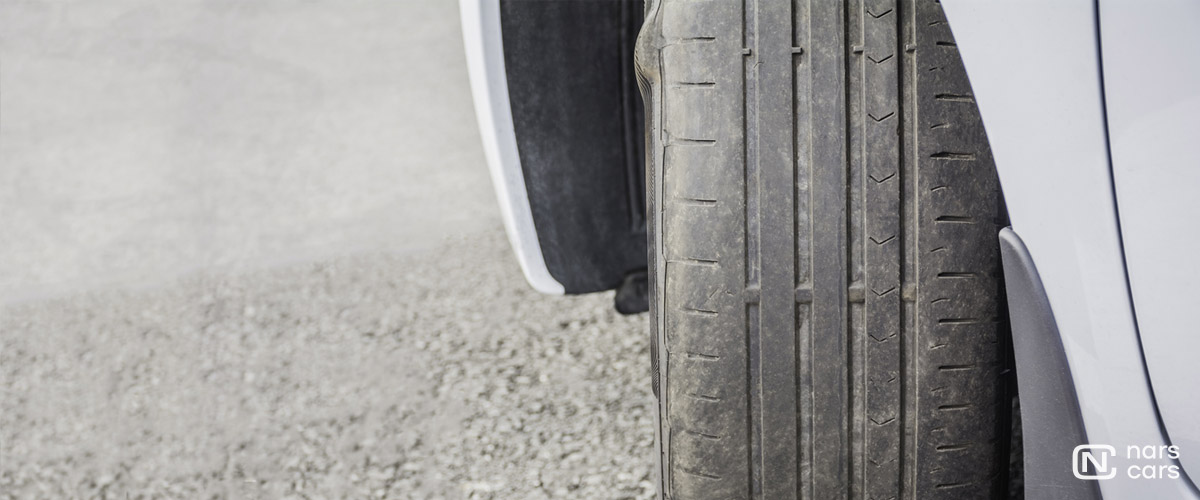
The permissible tread depth for winter tyres in Ukraine is 4 mm. This requirement is set out in the Traffic Regulations and is due to the specific operating conditions during the cold season. For comparison: summer tyres are permitted for use at a depth of 1.6 mm, as they operate in less demanding conditions.
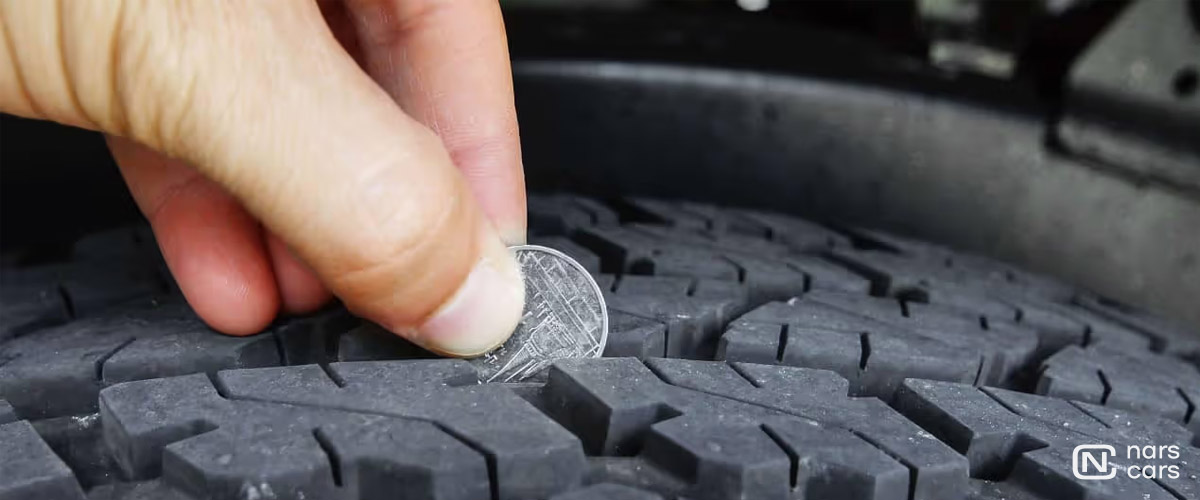
The condition of tyres is checked during technical inspections and patrol police checks. Inspectors use a special depth gauge that provides accurate results within seconds.
The fine for bald tyres is 340–680 hryvnia. For a repeat offence within a year, the amount doubles. An additional penalty is a ban on operating the vehicle until the fault is rectified.
However, the fine is only a small part of potential financial losses. In the event of an accident, the insurance company carefully examines the circumstances. Tyre wear is recorded in the report, and if the tread depth is below the permitted level, this is considered a violation of operating conditions. The insurer has the right to reduce the payout or refuse it entirely. In such a case, the person at fault must cover the repair costs of the damaged vehicles themselves.
Safety included in the price: why renting from NarsCars is more cost-effective than buying new tyres
A set of high-quality winter tyres costs between 8,000–20,000 hryvnia, depending on size and manufacturer. To this must be added tyre fitting costs (800–1,200 hryvnia), seasonal storage (500–1,000 hryvnia), and after 4–5 years — replacement due to wear or ageing.
An alternative approach is renting a car with guaranteed serviceable tyres. NarsCars maintains its fleet according to strict regulations: tread depth is checked before each rental, tyre age is monitored, and pressure is set in accordance with the manufacturer’s recommendations.
This approach is particularly relevant for winter travel. A trip to the Carpathians during the holidays, a business trip to another city, or an airport transfer during snowfall — in all these scenarios, road safety is ensured without additional expenses or hassle.
Booking through the website narscars.com.ua takes just a few minutes. You can choose the vehicle class, transmission type and fuel type. The pick-up and return process is organised for maximum customer convenience.